
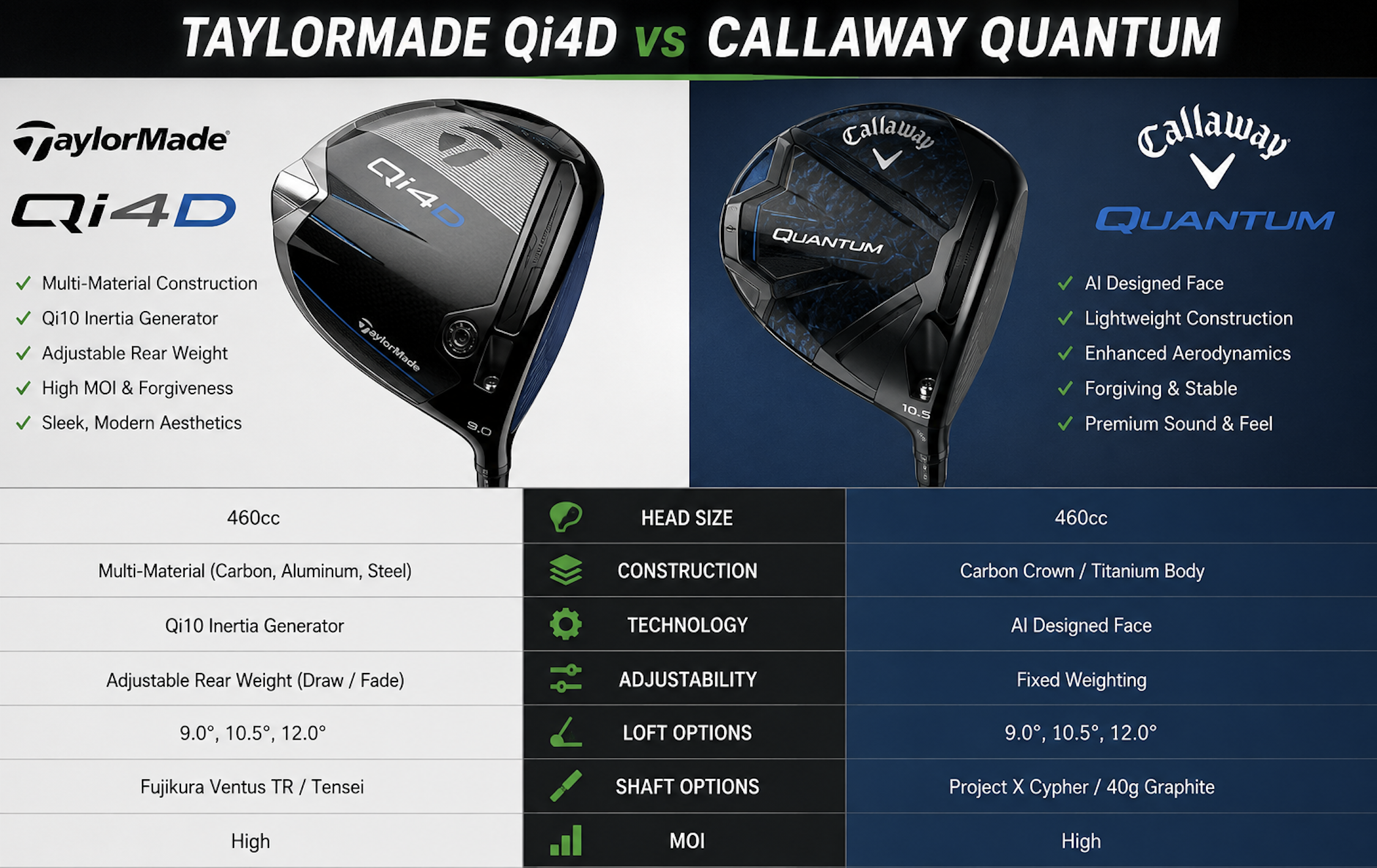
TaylorMade Qi4D vs. Callaway Quantum: What the New 2026 Drivers Actually Mean If You're a High Handicapper
If you've been anywhere near a golf shop, a driving range, or your group chat with the guys this year, you've heard the buzz. TaylorMade dropped the Qi4D family and Callaway fired back with the Quantum line. Both companies are throwing around words like "revolutionary," "fastest ever," and "quantum leap." Scottie Scheffler's gaming one. Rory's gaming the other. Marketing departments are having a field day.
Here's the question nobody's answering for you: does any of this actually matter if you're carrying a 15, 20, or 25 handicap?
Short answer... yes, some of it does. Let's break down what's actually new, and more importantly, what it means for your game if you're a mid-to-high handicapper trying to shoot lower scores instead of chasing a number on a Trackman screen.
What TaylorMade Actually Changed With the Qi4D
TaylorMade's new lineup — Qi4D, Qi4D LS, Qi4D Max, and Qi4D Max Lite — replaces the Qi35 series, and the headline feature is a redesigned carbon face with a new roll radius built to cut down spin variability on strikes that aren't dead center. That last part is the one worth underlining if you're not a scratch golfer: TaylorMade specifically engineered this to help shots that miss the sweet spot behave more predictably.
The Max model is the one most high-handicap players should actually pay attention to. It's built around forgiveness first, with a lighter, aircraft-grade aluminum collar that lets engineers push more weight to the perimeter of the clubhead... which is what actually increases forgiveness on off-center hits. TaylorMade also rolled out a new shaft-fitting system that groups golfers by how they rotate the club through impact instead of the old "stiff, regular, senior" buckets that never told anyone anything useful anyway.
What Callaway Did With the Quantum Line
Callaway went a different direction and widened the lineup instead of just refreshing one flagship head. For 2026 they're offering five distinct Quantum drivers, each built for a specific type of miss or swing: the Max for forgiveness, the Max D specifically built to fight a slice, a lightweight Max Fast for slower swing speeds, and two lower-spin Triple Diamond heads for better players.
The face technology here is called Tri-Force... three layered materials (titanium, a polymer mesh, and carbon fiber) designed to flex more efficiently and hold ball speed on mis-hits. The Quantum Max D is the one that should catch a high-handicapper's attention immediately, because a slice is the single most common miss we see in our schools, and it's usually a swing-path problem that a draw-biased head can genuinely help mask while you're working on the real fix.
Here's the Part the Commercials Won't Tell You
New driver technology every year has one job: convince you that this year's forgiveness is different from last year's forgiveness. And to be fair, driver forgiveness has genuinely improved over the last decade... MOI numbers keep climbing, and off-center strikes really do fly straighter and longer than they did ten years ago.
But forgiveness has a ceiling. A driver can't fix a swing path that's 8 degrees out to in. It can't fix an early release, a chicken-wing through impact, or contact that's low on the face every single time. What these drivers do... the Qi4D Max, the Quantum Max, the Max D — is widen your margin for error on the misses that are already close. They will not turn a two-groove miss into a fairway.
This is the exact conversation we have with new students at every one of our schools. A better driver is not a substitute for understanding what your swing is actually doing at impact. It's a complement to it.
Where Instruction and Equipment Actually Meet
If you're a high handicapper thinking about a new driver this year, here's the order of operations we'd actually recommend, and it's the same order we build our schools around:
1. Find out what your miss actually is before you buy anything. A slice, a low pull-hook, and inconsistent contact all get fixed differently, and they all get fit differently too. Buying a Quantum Max D because your buddy fixed his slice with one, when your actual miss is a heel strike, is how people end up with three drivers in the garage that all feel wrong.
2. Get fit, don't guess. Both of these new lineups leaned hard into fitting-specific tech this year... TaylorMade's rotation-based shaft system and Callaway's expanded model range are both, frankly, a response to how much scoring impact a proper fitting has versus buying off the rack. If you're going to spend $600 on a driver, spend 45 minutes getting fit for it.
3. Pair the new equipment with actual reps on your fundamentals. This is where our TTG Method™ comes in... we built it specifically around identifying what's actually happening in your swing (Pinpoint), making the right adjustment for your specific miss (Adjust), and then grooving it under real pressure so it holds up on the course, not just the range (Refine). A more forgiving driver head buys you time and margin while that process happens. It's not a shortcut around it.
The Bottom Line
The Qi4D and Quantum lines are both legitimately good pieces of engineering, and if you're overdue for a new driver, 2026 is a genuinely good year to buy one... particularly if your current driver is more than five years old, since forgiveness gains really have been real generation over generation. TaylorMade's Qi4D Max and Callaway's Quantum Max D in particular are worth a serious look if your miss trends toward a slice or inconsistent center-face contact.
Just don't expect the driver to do the work your swing needs to do. New technology raises your floor. It doesn't replace a fix.
If you want to actually find out what's causing your miss... not guess at it, not buy your way around it... that's exactly what our 3-day schools are built to diagnose and start fixing. See where we're running schools near you and let's find out what your swing is actually doing before you spend $600 on a driver that can only do half the job.
Have you tried the new Qi4D or Quantum drivers yet? We'd love to hear what you're finding on the course — reach out and let us know.